
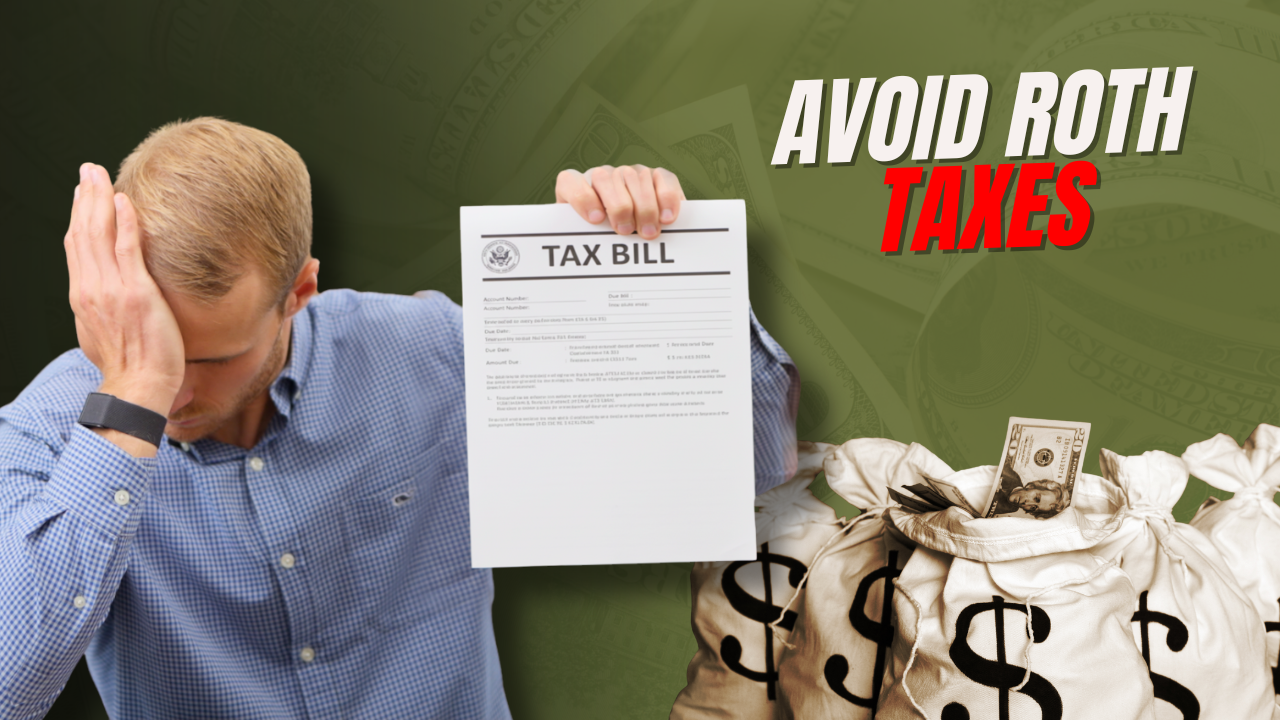
TRANSCRIPT:
Did you know that a simple misstep in your backdoor Roth IRA strategy could lead to unexpected taxes? Let’s make sure you keep more of your hard-earned money.
Hi, I’m Hunter Brockway, founder of Boca Retirement. I help guide people toward a successful, stress-free retirement, so they can spend more and avoid being crushed by unnecessary taxes.
Today, we’re diving into the backdoor Roth IRA, a powerful tool that allows high-income earners to enjoy tax-free growth in retirement. But beware, there are two common pitfalls that can turn this strategy into a tax headache.
First, the pro-rata rule.
Imagine mixing cream into your coffee. Once it’s mixed, you can’t separate it again. The IRS views your IRAs the same way.
If you have both pre-tax and after-tax money in a traditional IRA, the IRS treats them as one combined account. When you convert funds to a Roth IRA, the taxable and non-taxable portions are calculated proportionally.
For example, if 80% of your IRA funds are pre-tax and 20% are after-tax, then 80% of your Roth conversion will be taxable.
One way to avoid this is by rolling your pre-tax IRA funds into a 401(k) plan, which is not subject to the pro-rata rule. That can leave only after-tax dollars in your IRA, allowing for a potentially tax-free Roth conversion.
If this video has you thinking about your own retirement planning, I’d like to offer something that can help you see the bigger picture.
We’ve created a tax-smart, comprehensive retirement workbook designed for pre-retirees and retirees.
One thing I’ve noticed over the years is that there’s always at least one moment where someone says, “I hadn’t thought about that before.” No matter how smart they are or how much they’ve saved, something comes up.
Sometimes they realize they can spend more than they thought. Other times they discover their tax bill may be higher than expected, or that their current Social Security claiming strategy could leave money on the table.
This workbook walks you through the most critical areas of retirement planning, with action steps, common false beliefs, and space for your own reflections.
You can download the workbook using the link in the description below. If you have any trouble with the link, email us at contact@bocaretirement.com.
If you work through the workbook and would like your responses reviewed, or if you have questions, I’m happy to have that conversation with you. As always, there’s no cost, no obligation, and no pressure.
Now, the second pitfall: the timing myth.
There’s a common belief that you must wait a specific amount of time between contributing to a traditional IRA and converting to a Roth IRA in order to avoid IRS penalties.
The reality is that the IRS has not issued clear guidance requiring a specific waiting period. Many financial professionals agree that converting soon after the contribution can minimize potential earnings, which could otherwise be taxable.
That said, to err on the side of caution, some people choose to wait a few days or even a month before converting.
By understanding and navigating these rules, you can use the backdoor Roth IRA strategy more effectively and with greater confidence.
If you have questions or would like personalized guidance, feel free to reach out. You can contact us at contact@bocaretirement.com.
Best of luck, and thanks for watching.